
Cosmetic products must be free from harmful impurities, including heavy metals such as lead (Pb), cadmium (Cd), mercury (Hg), and arsenic (As), which can arise from raw materials, manufacturing processes, or contamination during storage.
These unwanted substances pose risks to consumer health and can lead to regulatory non-compliance. Regular impurity testing ensures product safety and adherence to global regulations.
Testing for impurities
Regulatory Compliance
- EU Cosmetics Regulation (EC No 1223/2009) – Requires that impurities are kept at safe levels and not present in harmful concentrations.
- US FDA & Prop 65 (California’s Safe Drinking Water and Toxic Enforcement Act) – Mandates strict limits for toxic substances in cosmetics.
- Health Canada – Regulates cosmetic ingredients to ensure safety and prevent contamination.
Cosmetic Products That Require Impurities Testing
Many cosmetic products may contain unwanted impurities due to raw material sourcing, formulation, or storage. Below is a list of products that we work with regularly and recommend testing as part of the compliance process.
If your product isn’t listed, contact our compliance team for guidance. Don’t get caught out—it’s always better to conduct impurity testing early to avoid costly recalls, legal issues, or regulatory rejections.
- Skincare & Moisturizers – May contain residual solvents, preservatives, or microbial contaminants.
- Sunscreens – Require testing for benzophenone, organic UV filter degradation, and stability-related impurities.
- Hair Dyes & Bleaching Agents – Potential impurities include p-phenylenediamine (PPD) oxidation by-products.
- Lipsticks & Lip Balms – Can contain residual solvents, PAHs (polycyclic aromatic hydrocarbons), or unwanted additives.
- Fragrances & Essential Oils – Need analysis for allergens, residual solvents, and oxidation by-products.
- Talc-Based Powders & Clays – Require asbestos and microbiological contamination testing.
Testing for heavy metals
Regulatory Compliance
- EU Regulations (EC No 1223/2009) – Heavy metals are prohibited but may be present as trace contaminants. Regulatory enforcement has increased, with more frequent testing by authorities across the EU. The German BVH has introduced significantly lower recommended limits than previous guidance, and these are increasingly being referenced by EU regulators.
- US FDA & Prop 65 (California’s Safe Drinking Water and Toxic Enforcement Act) – Strict limits for lead and other metals in cosmetics.
- Health Canada – Heavy metal restrictions in cosmetic ingredients and final formulations.
Many cosmetic products benefit from testing for heavy metals and other impurities. Below is a list of products that we work with regularly and recommend testing as part of the general compliance process.
If your product isn’t listed, contact our compliance team for guidance. Don’t get caught out—it’s always better to conduct compliance testing upfront to avoid delays, legal issues, or recalls which can be extremely costly.
- Lipsticks & Lip Balms – High-risk due to pigment and mineral-based ingredients.
- Eyeshadows & Mascaras – Potential contamination from colorants and minerals.
- Foundations & Powders – Often contain natural clays or talc that may carry impurities.
- Sunscreens & Skincare – Heavy metals can be present in UV filters or mineral-based components.
- Tattoo Inks & Hair Dyes – Require stringent testing due to direct skin exposure
Testing services and pricing
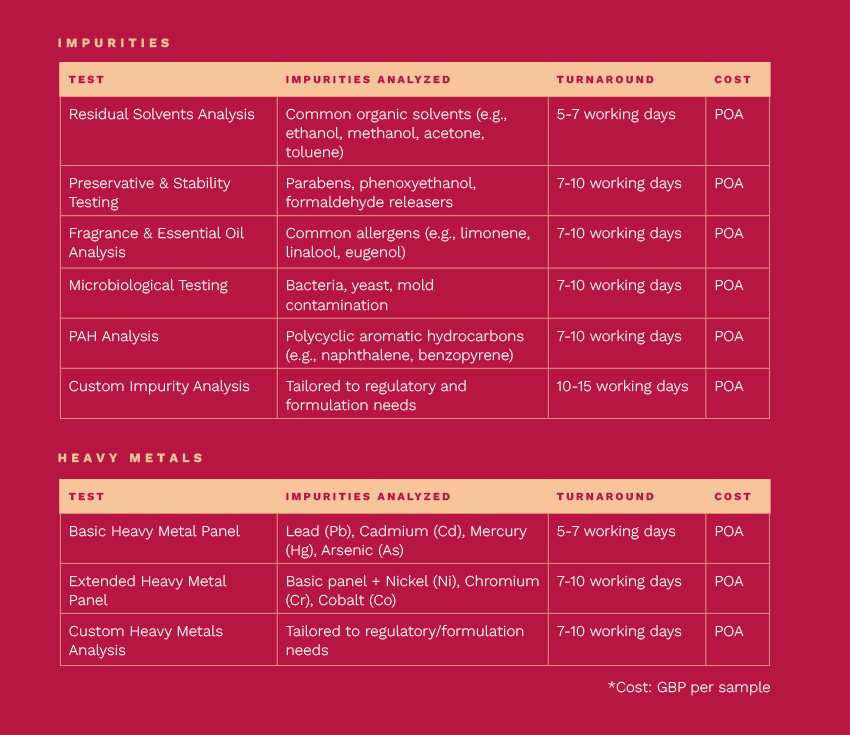
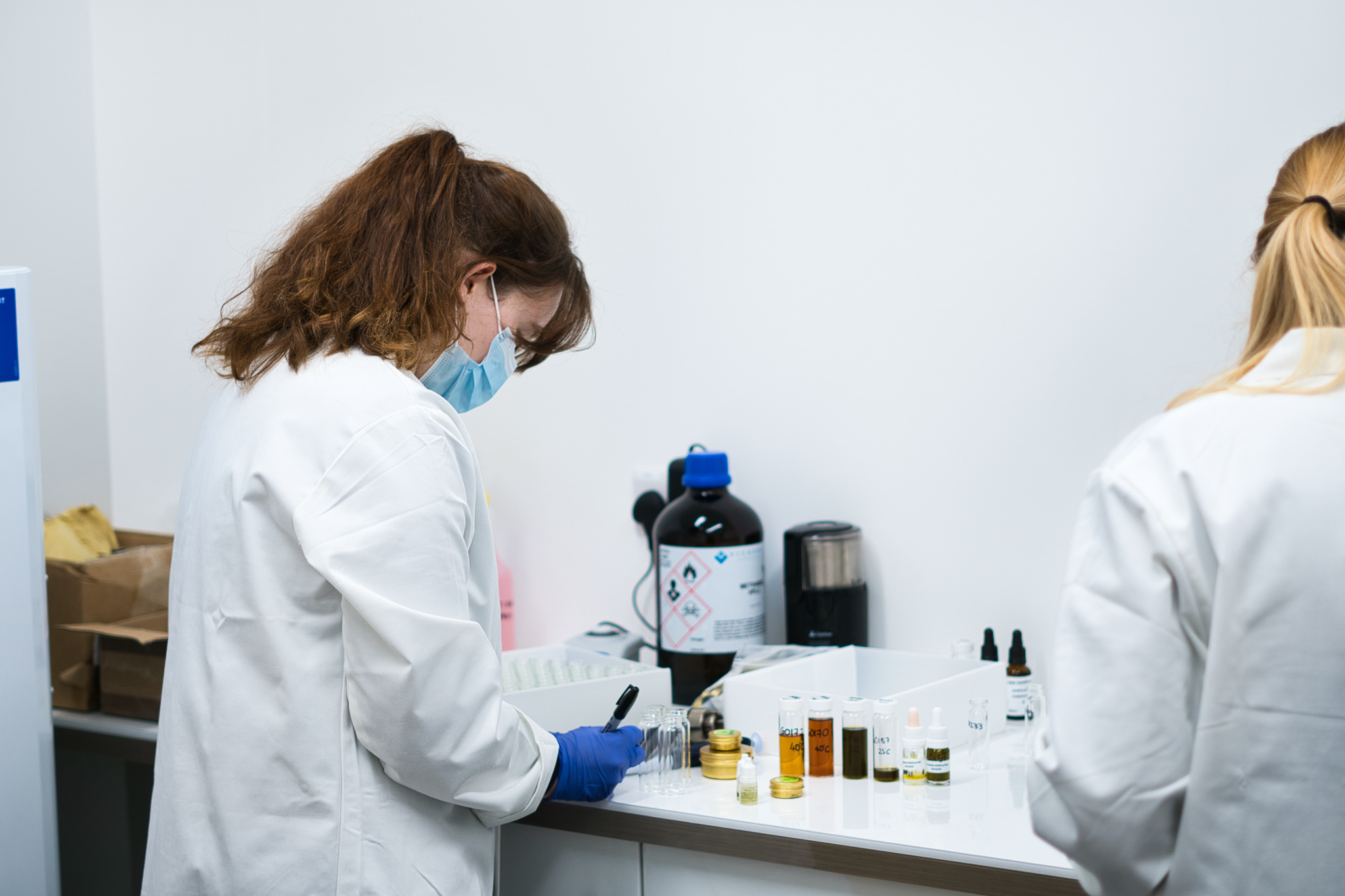
Our laboratory provides advanced impurity detection using HPLC, GC-MS, and other analytical techniques to ensure the highest levels of accuracy and compliance. For heavy metals, we offer comprehensive testing using ICP-MS (Inductively Coupled Plasma Mass Spectrometry) for precise and reliable results.